
Multi-Night Sleep Studies Dramatically Improve Apnea Diagnoses
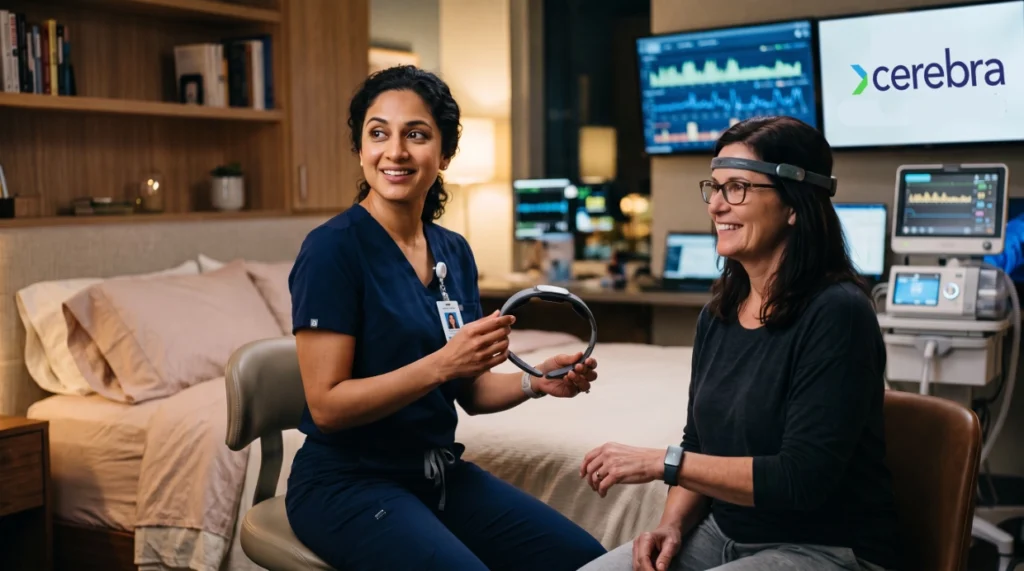
A multi-night sleep study is a more technically sound way to determine if a patient experiences sleep apnea. One night of sleep study, on the other hand, can be technically sound but still place a patient on the wrong side of a diagnostic cutoff from their multi-night average. In a three-night home-testing study of 10,340 adults, about 23% of people whose combined results indicated mild obstructive sleep apnea appeared not to have OSA on an individual night. About 22% of those with moderate OSA appeared to have only mild disease.
Those figures describe the problem behind a 2026 international expert panel’s support for selective multi-night OSA testing. Its argument was narrow: several nights may be useful when the first result is borderline, substantial night-to-night variation is suspected, or the test does not fit the patient’s symptoms and clinical history.
Why an AHI Can Change Overnight
Sleep studies commonly summarize obstructive breathing with the apnea-hypopnea index, or AHI: the number of apneas and hypopneas recorded per hour. Common severity bands place fewer than five events an hour below the OSA threshold, 5 to 14.9 in the mild range, 15 to 29.9 in the moderate range and 30 or more in the severe range. Diagnosis also incorporates symptoms and medical history.
These thresholds look exact, but the physiology they summarize is variable. A hypothetical AHI of 4.8 one night and 5.4 on another crosses the numerical threshold even though the difference is small. Results of 14.7 and 15.2 receive different severity labels for the same reason.
A person may spend more time on their back one night and on their side the next. The amount of rapid-eye-movement sleep also changes. Both can alter airway collapsibility and the frequency of obstructive events. Nasal congestion, shifts in body fluid, total sleep time and measurement or scoring variation can contribute as well.
A systematic review of 24 studies involving 3,250 adults found that 41% had a night-to-night change of more than 10 respiratory events an hour. Almost half crossed an OSA severity category at least once. The group average barely changed; the clinically important movement occurred within individual patients.
What the 2026 Panel Supported
The paper used a modified Delphi process. Thirteen international sleep-medicine experts rated statements in two rounds, and agreement of at least 70% counted as consensus. The panel reached that mark on 12 of 17 statements.
Three valid nights were considered a reasonable compromise between obtaining more representative information and asking too much of patients and clinics. The experts favored completing the nights within one month, reducing the chance that a change in health or treatment would make them incomparable. They also supported using the mean AHI across valid nights to inform treatment recommendations.
The panel reached consensus on averaging results for treatment decisions, but not on using a mean AHI to diagnose or exclude OSA. Three nights were selected for practicality, not established as a universal optimum. This was expert opinion rather than a patient trial or formal guideline. The panel was small, its response rate was 22%, and most participants worked in Western tertiary-care centers.
Who Might Benefit From Additional Nights?
The strongest case is a gray-zone result. An AHI close to 5 can affect whether OSA is recorded at all; a result close to 15 or 30 can change the reported severity. Another candidate is a patient whose study showed little time on the back or little REM sleep despite a history strongly suggestive of OSA. A technically adequate but unexpectedly low result deserves clinical review rather than automatic reassurance.
Additional nights offer less new information when a well-conducted study shows unmistakably severe OSA. In the 10,340-person study, more than 87% of people classified as severe on an individual night remained severe against the three-night reference. The panel also concluded that cost and practicality weighed against routine multi-night testing in uncomplicated cases.
The Device Still Determines What Can Be Diagnosed
The panel did not agree that pulse oximetry or other simplified devices were adequate for extended testing. An oximeter records blood-oxygen saturation; it does not independently measure airflow, breathing effort or brain activity. Repeating a narrow measurement three times does not turn it into polysomnography.
Current American Academy of Sleep Medicine guidance still recommends laboratory polysomnography after a negative, inconclusive or technically inadequate home sleep apnea test when OSA remains suspected. Laboratory testing is also preferred when medical conditions can make limited-channel home testing unreliable, including significant cardiorespiratory or neuromuscular disease, suspected hypoventilation, chronic opioid use, previous stroke or severe insomnia.
Implementation remains limited. In a separate 2026 survey of 43 clinicians at 28 European sleep centers, 83% believed multi-night testing could reduce misclassification, but only seven centers used multi-night protocols. Staffing, reimbursement and the absence of standardized guidelines were the main barriers.
For now, multi-night testing has a specific role: clarifying an uncertain result. It gives clinicians a broader sample when one night sits near a cutoff or conflicts with the clinical picture, while decisive studies remain decisive. Used selectively, it reduces the chance that a variable night becomes a permanent diagnostic label.